WeekendTest hero

The Weekend Test: How to Find Swag Your People Actually Want

How to make swag your employees, community and customers use
Author: Eric Hamlin
Author’s note: A former customer, Jason Dunn, recently reminded us of and old blog a former Kotisian wrote in their time here. The piece was archived, but never published. When Jason advised community swag managers to measure the worth of swag using what he calls “the laptop test,” [link] we were inspired to resurface the piece. We updated the original piece so that it’s current and aligns with our take, while keeping the original concept, key points and voice.
Sure, your goal is to increase brand exposure and impressions. At the end of the day though, the core of handing out a piece of swag is to get the recipient to use it.

Other forms of advertising like display, digital, and television require an audience; typically that audience has very little say in how they receive the advertisement. They’re held hostage by the medium. Phyisical product is different. Brand exposure is a direct result of swag getting used. Swag is still media.

Said another way: the more people use your swag --> the more they (and other people) see the brand --> the more impressions/exposure your brand receives.

So, how can you maximize your brand exposure using swag? It’s not just a numbers game, putting out the most “stuff” with your logo brings in more leads. It’s a thoughtful, deliberate approach to transforming your employees, customers, or prospects into brand evangelists. Here's how we approach it with our own brand.

Recently, we were reminded of how we approached this by our client, Jason Dunn. Jason spoke about measuring your swag’s worth using what he calls “the laptop test.”

At Kotis, we’ve always started our own projects by asking a very similar question: Would our recipients wear this on the weekend?
We call it “The Weekend Test.”
If you're going to take the time to give someone (an employee, a prospect, or a customer) a piece of branded merchandise, you should look at it from three angles:
- What's IN it
- What's ON it
- What does it STAND for?
To illustrate, we’ll take a t-shirt.
Now, bear with me for a moment, I’m kind of a t-shirt nerd. I’ve gone as far as professing my love for t-shirts on LinkedIn and I spend more time thinking about fabric blends than I care to admit. It probably comes with the territory after printing them for nearly 15 years, but out of all promotional products, perhaps people establish the deepest relationship with t-shirts.
Think for a second, what’s your favorite t-shirt? Most people have one. Whether you’re around the house, running errands, or at work on casual Friday, it’s the item that gets used.
It’s also the item that faces the most scrutiny. Below I’ll explain the three checkboxes you must get right for someone to wear your shirt on the weekend.

What's in the shirt?

Not all shirts are created equal. Raw materials, fabrication, and fit all impact the quality of the garment, which in turn impacts the wearability of the shirt.

The ultimate weekend approved tee should be comfy, yet durable. Forgiving, yet shape-holding.

We prefer a good amount of cotton in our shirts. As a natural fiber, it prints, breathes, and feels better. However, too much cotton means that fabric is prone to wrinkling and shrinkage, so it's a good idea to find a blended fabric that includes another fiber type to give the garment a bit of structure.

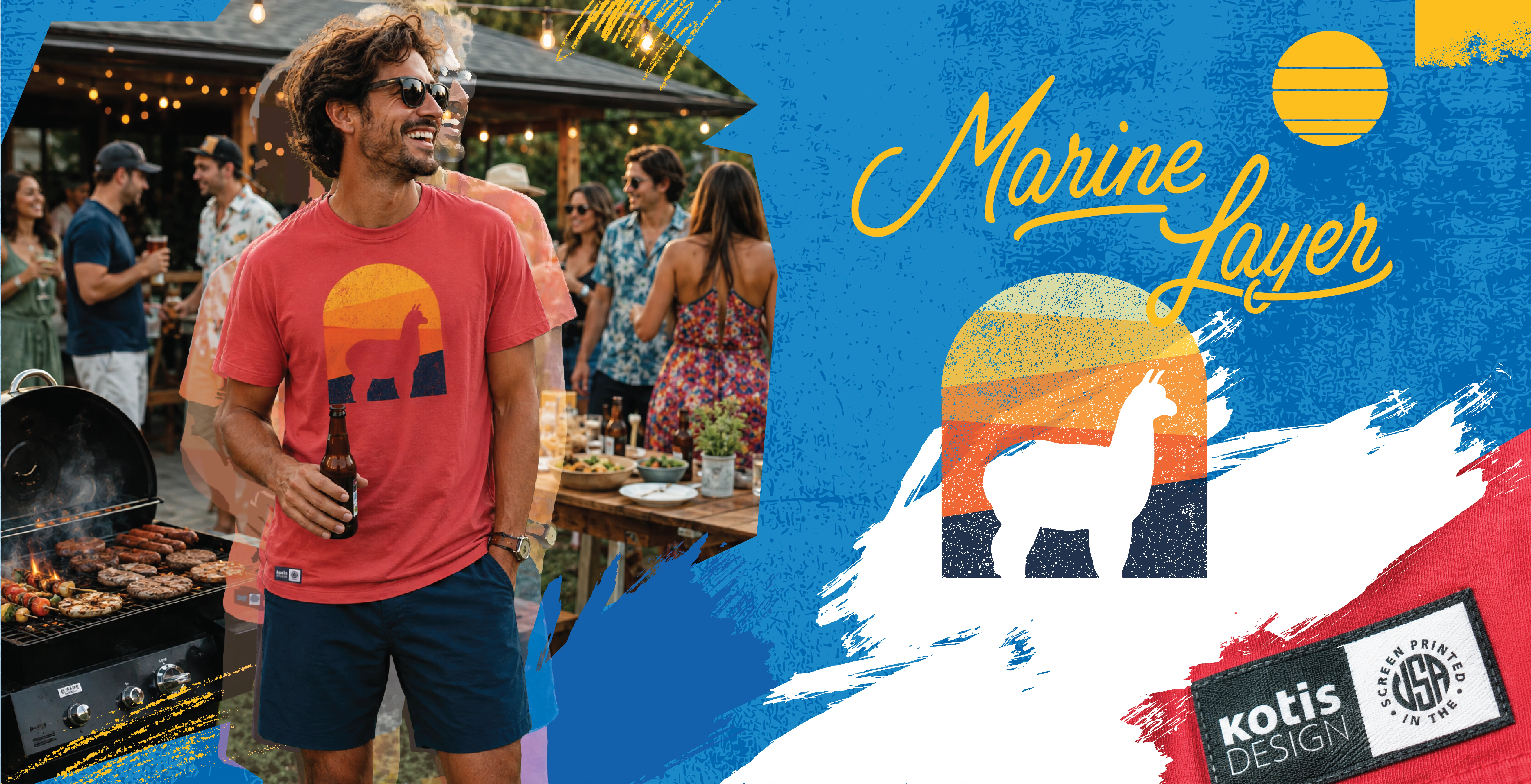
For our weekend worthy tee, we went with the Marine Layer Signature Crew. The fabric is 50% Supima Cotton, 50% Micromodal. We found that this blend gave the shirt the perfect combination of softness and structure, and has proven itself to hold up, wash after wash. We've also had success with the Next Level CVC tee and the Stanley/Stella Creator 2.0 Vintage tee.

For cotton, there are varying degrees of quality when it comes to cotton fibers. Supima cotton is a type of cotton grown in the US. It has an extra-long staple (which is what gives it softness and strength). Fun fact, less than 1% of the cotton grown in the world is Supima.

You may have also heard of MicroModal (pronounced MO-duhl). This is a sustainable fabric, made from renewably grown beechwood trees. Also, very comfortable and highly durable.

As a closing thought on the physical shirt, if you're always picking the cheapest shirt, you might as well pause and save your budget for something better. Give people a reason to wear your shirt.

The average shirt gets 3,400 impressions over its lifetime according to Advertising Specialty Institute (ASI). A high-quality tee will beat that average.

What's on the shirt?

Next up, we put a lot of thought into the design of the shirt. Our goal is to create a highly wearable design, incorporating the latest trends in graphic tees. We're big on animals and adventure, so the Alpaca was a good fit. We deliberately minimized Kotis branding on the shirt, going so far as to not include our company name in the design itself. Instead, we developed a woven label "locker tag" that we sewed near the right-hand lower hem. This gives the piece a premium, retail feel.

Production-wise, we applied a vintage filter to the design because retro-style apparel is truly a timeless trend. We leveraged the shirt color itself through negative space for the alpaca. This low ink-coverage approach in combination with specialty inks, resulted in a softer hand (the feel of the ink on a shirt is called the "hand"). To us, a softer hand = more comfortable everyday use.

TIP:

Don't just print your corporate logo center chest, unless you've got an iconic brand. No offense, most companies don’t. Theme the design around your audience. Clever sayings and graphics that align with your industry, or creating images based on your mascotare great ways to appeal to a wider audience.

What does it stand for?

Ryan Holmes, the CEO of Hootsuite, wrote a great article in Inc labeled "How to Create Company Swag that You'll Actually Want to Wear". While the article was written a few years ago, the message still rings true. He writes that good swag is like a secret handshake.

In other words, swag telegraphs to the public a type of "membership" in an exclusive club. Tap into a passionate fan base and give them a way to literally wear their values on their sleeve. Think of it as a constant, passive endorsement of your company, wherever, whenever someone is wearing your shirt.

That passive endorsement is worth a whole lot more than trying to send out walking billboards for your company logo.

For us, we wanted to add a layer of social responsibility to the equation, which is yet another reason we picked Marine Layer. They have a sustainable mission and are made in the USA.

Backing it up, we have reported our GHG emissions and educated our staff on best practices to reduce environmental impact with effective swag. This Marine Layer shirt is an extension of what we already believe in. It’s a natural extension of Kotis as a brand.

Why does it matter?

Promotional products shouldn’t purely be a numbers game. Your swag is a physical manifestation of your brand. The moment your employee, customer, or prospect touches that item, its quality impacts their view of your company. Leverage that. A well-produced, thoughtful t-shirt has a lower impression cost, 3/10th of a cent per impression for a t-shirt, than any other medium. To accomplish that, however, people actually need to wear the swag you produce.

Next time you’re ordering swag, ask yourself: is this weekend worthy?

And if you’re wondering what my favorite shirt is…it’s our Alpaca tee 😊